
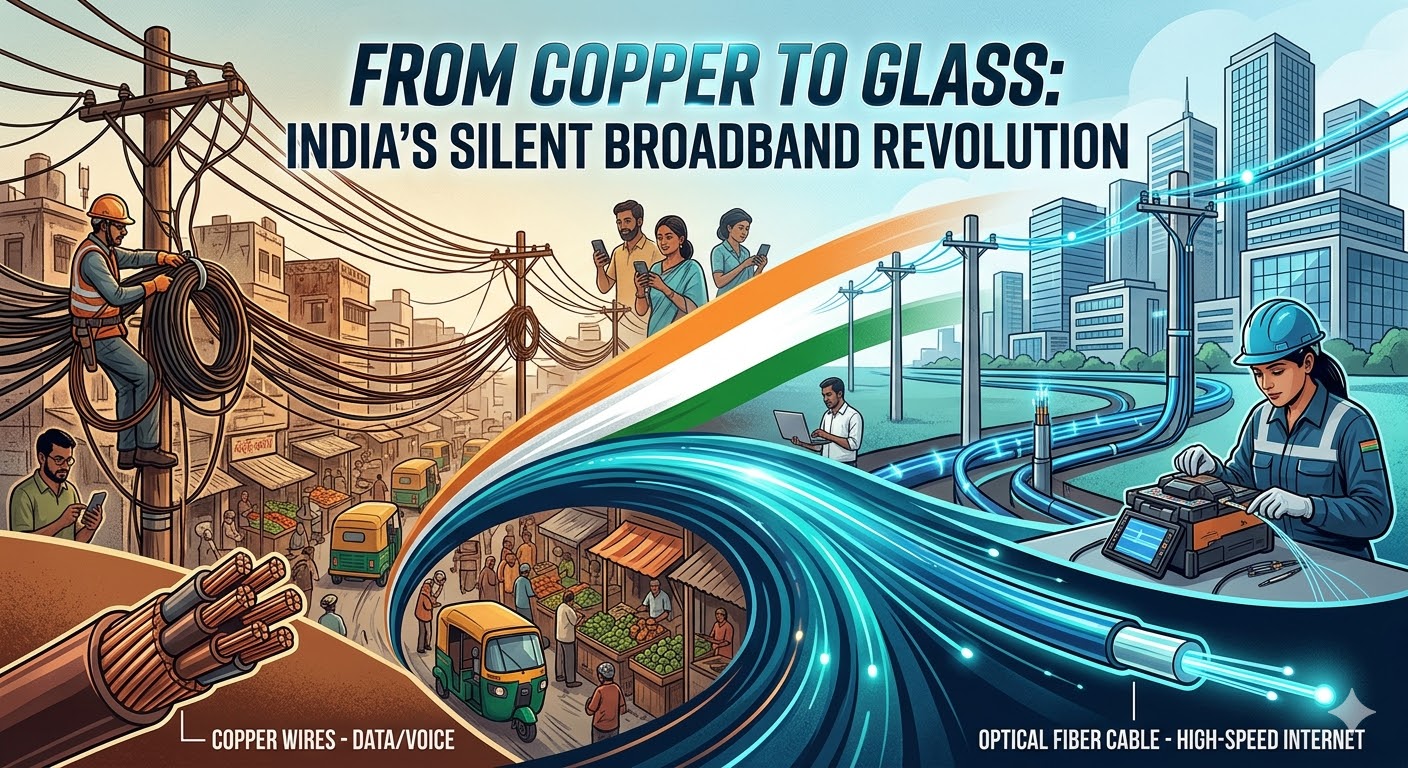
There’s a quiet revolution happening under India’s streets, and most people don’t even know it’s there.
For decades, India’s internet ran on copper — the same twisted-pair telephone lines that were designed to carry voice calls in the 1990s. BSNL’s DSL connections, maxing out at 8–24 Mbps on a good day, were the backbone of India’s early internet era. Those copper lines connected call centers, powered early e-commerce, and gave a generation their first taste of broadband.
But copper has a speed limit. And India hit it years ago.
The Copper Problem
Copper telephone cables suffer from a fundamental physics problem: signal degradation over distance. The further you are from the exchange, the slower your connection. At 5 kilometers from the nearest DSLAM, your “broadband” connection might deliver barely 2 Mbps.
Copper vs. Fiber: A Quick Comparison
| Feature | Copper (DSL) | Fiber (FTTH) |
|---|---|---|
| Max Speed | 24 Mbps (ADSL2+) | 1 Gbps+ |
| Distance Sensitivity | Severe — drops with distance | Minimal — consistent over 20+ km |
| Latency | 20–50 ms | 1–5 ms |
| Upload Speed | 1–3 Mbps | Symmetric (same as download) |
| Weather Impact | Affected by moisture, heat | Immune |
| Lifespan | 20–25 years | 50+ years |
India’s copper network was also aging badly. Cables laid in the 1990s were corroding. Waterlogging during monsoons would knock out entire exchanges. The maintenance cost of keeping copper alive was exceeding the cost of replacing it with fiber.
BharatNet: The Ambitious Promise
In 2011, the Indian government launched what would become the world’s largest rural broadband project: BharatNet (originally the National Optical Fibre Network).
The goal was staggering: connect all 250,000+ gram panchayats (village-level administrative units) with fiber-optic cable, delivering at least 100 Mbps to every village.
The Numbers
- Target: 250,000+ gram panchayats
- Fiber laid (as of 2025): ~600,000+ km
- Gram panchayats connected: ~200,000
- Investment: Over ₹40,000 crore ($5+ billion)
The execution has been uneven. Some states — Kerala, Karnataka, Tamil Nadu — moved fast, leveraging existing infrastructure and state-level fiber networks. Others — particularly in the northeast and hilly regions — faced terrain challenges that made laying fiber extraordinarily difficult.
The Private Sector Leap
While BharatNet focused on the backbone, private ISPs transformed the last mile.
Jio’s 4G launch in 2016 was the catalyst. By offering free data for months, Reliance didn’t just build a telecom company — they created 400 million smartphone users who expected fast, cheap internet as a basic utility. India’s average data consumption went from around 0.2 GB/month per user to over 20 GB/month within five years.
But 4G towers need backhaul. That backhaul is fiber. Jio alone has laid over 900,000 km of fiber across India — more than enough to wrap around the Earth 22 times.
Airtel, Vi, and regional ISPs followed. The competition drove prices to levels that would be unthinkable anywhere else in the world: 1 Gbps fiber connections for under ₹1,000/month.
FTTH: The Last Mile Challenge
Getting fiber to your home — Fiber-to-the-Home (FTTH) — is the hardest part. The backbone might be in place, but the last 500 meters from the street to your living room involves:
- Right-of-way permissions from municipal bodies
- Digging or aerial stringing through congested neighborhoods
- Building entry agreements — many housing societies resist new cable installations
- Trained technicians for splicing and ONT (Optical Network Terminal) installation
In cities like Kolkata, where narrow lanes and dense construction make underground trenching nearly impossible, ISPs have turned to aerial fiber — strung along existing poles. It’s not pretty, but it works.
For ISPs like Fibrix, serving areas like Baruipur in South 24 Parganas, the challenge is bridging the gap between the nearest backbone fiber point and individual homes. Every meter of fiber laid, every splice made, every ONT installed is a small victory in this quiet revolution.
The 5G Multiplier
India’s 5G rollout has added another dimension to the fiber story. Every 5G tower needs fiber backhaul — you can’t deliver gigabit wireless speeds if the tower itself is connected by a 100 Mbps copper link.
The government estimates India needs over 3 million km of additional fiber to fully support 5G. That’s three times what BharatNet has laid so far.
This creates a virtuous cycle:
- More 5G towers → demand for more fiber
- More fiber → cheaper per-km cost → better economics for FTTH
- Better FTTH → faster home internet → more data consumption
- More data consumption → demand for more 5G towers
What 100 Mbps to Every Village Actually Means
When we talk about “100 Mbps to every village,” it’s easy to get lost in the technical jargon. Here’s what it means in practice:
- A farmer in rural Bihar can video-call an agricultural expert in real-time to diagnose crop disease.
- A student in Nagaland can attend live online classes without buffering.
- A small business owner can accept UPI payments, manage inventory online, and sell on e-commerce platforms — all things that require consistent, low-latency connectivity.
- Telemedicine becomes viable — a village health center can connect to a specialist in a city hospital.
The internet isn’t a luxury anymore. It’s infrastructure. Like roads, like electricity, like clean water.
The Road Ahead
India currently has around 40 million FTTH connections — a number that’s growing by millions each quarter. The government’s target of “fiber in every village by 2025” wasn’t fully met, but the trajectory is clear.
The copper era is ending. The glass era is here. And for a country of 1.4 billion people, the difference between 2 Mbps and 100 Mbps isn’t just about speed — it’s about opportunity.
Every fiber cable laid is a bridge. Between rural and urban. Between local and global. Between what India is and what it’s becoming.