

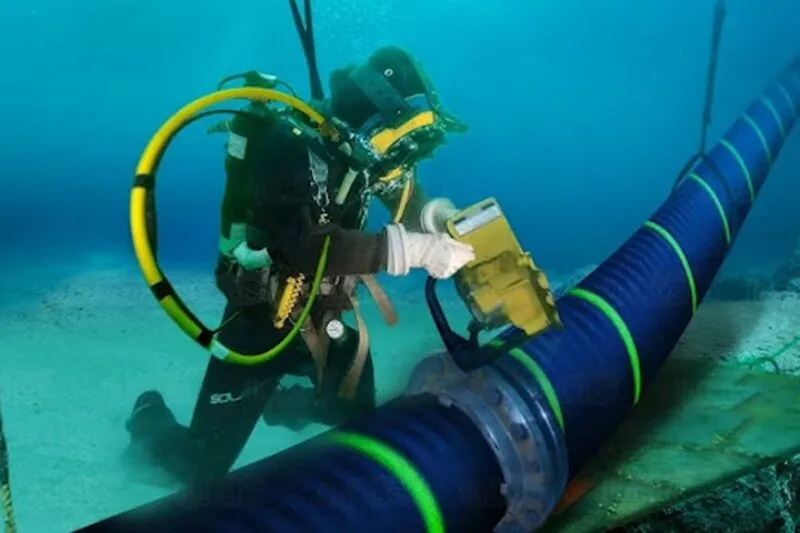
Right now, as you read this, 95% of all intercontinental internet traffic is flowing through cables sitting on the bottom of the ocean. Not through satellites. Not through radio waves. Through glass fibers thinner than a human hair, encased in a cable the width of a garden hose, resting on the seabed up to 8,000 meters below the surface.
There are over 500 submarine cables in operation worldwide, stretching more than 1.4 million kilometers — enough to circle the Earth 35 times. And building each one is among the most complex engineering feats on the planet.
Anatomy of a Submarine Cable
A submarine cable isn’t just a fiber-optic wire dropped into the ocean. It’s a precision-engineered structure designed to survive for 25+ years in one of the harshest environments on Earth.
Cross-Section (Deep-Water)
From the inside out:
- Optical fibers — typically 8–24 fiber pairs, each pair capable of carrying multiple terabits per second
- Jelly compound — protects fibers from water and pressure
- Copper tube — carries electrical power to the repeaters (amplifiers) along the cable
- Polyethylene insulation — waterproofing layer
- Steel wire armor — structural strength (only in shallow-water sections)
- Outer polyethylene sheath — final protective layer
Specifications at a Glance
| Feature | Typical Specification |
|---|---|
| Deep-water diameter | ~17 mm (garden hose) |
| Shallow-water diameter | ~50 mm (with armor) |
| Weight | 1.4 tonnes/km (deep) to 10+ tonnes/km (armored) |
| Fiber pairs | 8–24 |
| Capacity per pair | 20+ Tbps (modern systems) |
| Design life | 25 years |
| Power requirement | 10,000–15,000 volts DC |
| Repeater spacing | Every 60–100 km |
The deep-water version — where the cable spends most of its life — is remarkably thin because the water pressure at depth actually protects it from external damage. Near the coast, where fishing trawlers, anchors, and currents pose a threat, the cable gets progressively thicker armor layers.
The Cable Ships
Building a submarine cable starts with the ship. These aren’t ordinary vessels — they’re floating factories, purpose-built for one job: laying thousands of kilometers of cable with centimeter-level precision.
The world’s fleet of cable ships numbers only about 40 vessels. Major operators include SubCom (USA), Alcatel Submarine Networks (France), and NEC (Japan). Each ship can carry 5,000–8,000 km of cable in massive circular tanks below deck.
Key Features of a Cable Ship
- Cable tanks: Circular holds where cable is coiled in figure-8 patterns to prevent tangling. A single tank can hold thousands of kilometers.
- Cable engines: Massive drive systems that feed cable over the stern at a controlled speed — typically 1–2 km per hour during laying.
- Dynamic positioning: GPS-guided thrusters that keep the ship on the exact planned route, compensating for drift, current, and wind.
- Bow sheave/stern roller: The wheel over which the cable passes from ship to sea. It must be large enough to prevent bending the fiber beyond its minimum bend radius.
- Jointing room: Where fiber splices happen when cable segments are joined mid-ocean. A single splice can take 8–12 hours of painstaking work by specialized technicians.
The Route Survey
Before any cable is laid, the route is surveyed in extraordinary detail. This process can take 6–12 months and involves:
- Desktop study — analyzing existing charts, geological data, seismic activity, shipping lanes, and fishing zones
- Marine survey — a survey vessel maps the seabed using multibeam sonar, sometimes covering a corridor 1–2 km wide along the entire route
- Hazard identification — shipwrecks, unexploded ordnance (surprisingly common), existing cables, pipelines, and volcanic vents
- Sediment sampling — determining whether the seabed is suitable for burial
The survey data determines the exact cable route, the burial depth at each point, and the type of cable armor needed for each section.
The Laying Process
Shallow Water (0–1,000 m)
This is the dangerous zone. Close to shore, the cable is at risk from anchors, fishing nets, and wave action. Here, the cable is buried using one of two methods:
- Sea plow: A massive sled towed behind the cable ship that cuts a trench in the seabed, lays the cable, and backfills — all in one pass. Plows can bury cable 1–3 meters deep.
- ROV (Remotely Operated Vehicle) jetting: For rocky or uneven seabeds, an ROV uses high-pressure water jets to create a trench and settle the cable into it.
Deep Water (1,000–8,000 m)
In the deep ocean, the cable is simply laid on the seabed surface. At these depths, there’s virtually no human activity, and the water pressure and sediment provide natural protection.
The cable sinks to the bottom under its own weight as the ship moves forward. The ship’s speed, the cable payout rate, and ocean currents must be balanced precisely — too much slack and the cable piles up; too little and it’s suspended off the seabed, vulnerable to currents and abrasion.
Repeaters
Every 60–100 kilometers, an optical repeater (amplifier) is spliced into the cable. These are cylindrical units about 1.5 meters long and weigh around 300 kg. They contain erbium-doped fiber amplifiers (EDFAs) that boost the optical signal without converting it to electrical — keeping the data moving at the speed of light.
Repeaters are powered by the copper conductor in the cable. Power feeding equipment at each end of the cable pushes 10,000–15,000 volts DC through the conductor. The voltage is split across all repeaters in series — each one using a small fraction.
These repeaters must work continuously for 25 years without maintenance. There is no way to service them once they’re on the seabed. The reliability engineering is extraordinary.
The Numbers
A major submarine cable project involves:
- $200–500 million in total investment
- 2–3 years from planning to completion
- 5,000–15,000 km of cable manufactured and loaded
- 40–60 repeaters per ocean crossing
- 4–8 weeks of continuous laying at sea
- A crew of 80–100 working 12-hour shifts
The Landing Stations
At each end, the cable comes ashore at a Cable Landing Station (CLS). These are nondescript, heavily secured buildings — usually located in coastal towns — where the submarine cable connects to the terrestrial fiber network.
The transition from sea to land is one of the riskiest parts. The cable must cross the surf zone, navigate through near-shore rocks and sediment, and enter the building through a sealed conduit. This section is typically buried 3+ meters deep and protected by concrete mattresses or rock armor.
Landing stations also house the power feeding equipment, network monitoring systems, and the connections to terrestrial fiber that route the traffic to its final destination.
What Can Go Wrong
Despite all this engineering, submarine cables face constant threats:
- Fishing trawlers — responsible for the majority of cable faults worldwide
- Ship anchors — especially in busy shipping lanes near cable routes
- Earthquakes and landslides — underwater seismic events can snap cables across hundreds of kilometers
- Shark bites — yes, this actually happens, though it’s rarer than the legend suggests. Early cables used electrical fields that attracted sharks; modern cables are better shielded.
- Corrosion — in shallow, warm waters, marine growth and chemical reactions can degrade the outer sheath over decades.
Globally, there are approximately 100–150 cable faults per year. Each one requires a cable ship to sail to the location, grapple the cable from the seabed, cut out the damaged section, splice in a replacement, and re-lay it. A single repair can cost $1–3 million and take 2–4 weeks.
The Silent Backbone
The next time you video-call someone overseas, or stream a show from a server in another country, spare a thought for the cable beneath the ocean that makes it possible.
It was built by engineers who spent months at sea. It was laid by ships that move slower than walking pace, feeding cable over their sterns meter by meter. It’s powered by high-voltage DC running through a copper tube thinner than your finger. And it’s amplified by repeaters that will sit in total darkness, at crushing pressure, working flawlessly for a quarter of a century.
The internet isn’t in the cloud. It’s at the bottom of the ocean.