

There is a silent ghost ship of sorts currently haunting the North Atlantic, but it isn’t made of wood or iron. It’s made of glass.
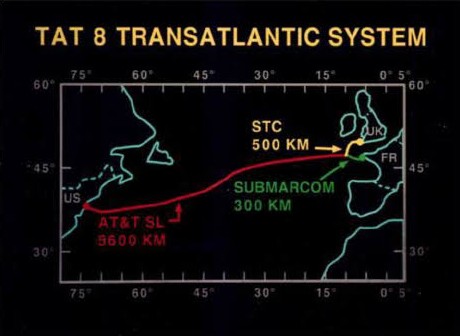
In 1988, a consortium of telecommunications giants did something that changed the world forever: they laid the TAT-8, the first-ever transatlantic fiber-optic cable. It was the physical bridge that allowed the digital age to cross the ocean. For fourteen years, it carried the pulses of the early internet, the fall of the Berlin Wall, and the first-ever transatlantic digital phone calls. Then, in 2002, it went dark.
Now, in 2026, we are finally bringing it home. This isn’t just a salvage operation; it is telecommunications archaeology.
The 18-Month Phenomenon
When the TAT-8 was first switched on, the engineers at Bell Labs and AT&T thought they had built enough capacity to last a decade. They were wrong. Within just 18 months, the cable was completely saturated.
The world’s hunger for data was exponential, not linear. That 1.3 μm wavelength light pulse was the starting gun for the modern world. Looking back at the specs today, they seem almost quaint, but in 1988, this was the equivalent of the moon landing for data.
The Original Pioneer: At a Glance
| Feature | TAT-8 Specification |
|---|---|
| Launched | December 14, 1988 |
| Core Technology | 1.3-micron single-mode fiber |
| Transmission Rate | 280 Mbit/s per fiber pair |
| Max Capacity | 40,000 simultaneous voice calls |
| Operating Depth | Down to 8,000 meters |
The Voyage of the MV Maasvliet
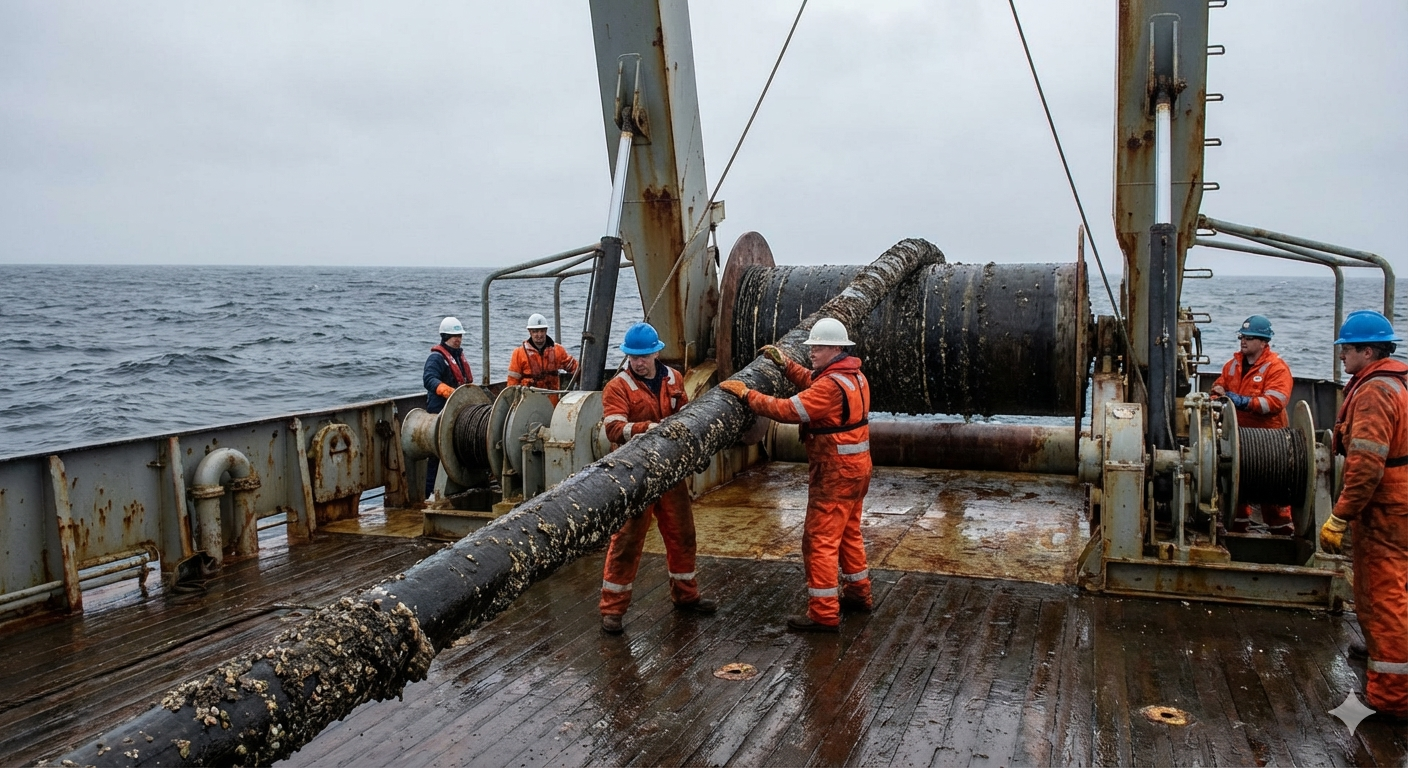
The recovery mission is being led by the MV Maasvliet, a beast of a vessel powered by three Volvo truck engines. But despite the high-tech diesel-electric propulsion, the work is surprisingly “low-tech” and incredibly dangerous.
Because TAT-8 was laid in an era before automated spooling, the cable has to be coiled by hand in the ship’s hold. Imagine 6,000 kilometers of garden-hose-thick cable, slippery with deep-sea silt, being guided into place by a multinational crew while dodging North Atlantic storms like Dexter and Erin.
Captain Vlad and his crew have been living this reality for months. It’s a world where Georgian soup dumplings (khinkali) prepared by the ship’s cook, Misha, are the only thing keeping morale high during a force-8 gale.
The Circular Economy: From the Abyss to the Factory
Why spend millions to pull up a “zombie” cable? The answer is simple: the world is running out of copper.
Once the cable is offloaded at the port of Leixões, it heads to Port Elizabeth, South Africa. There, a facility called Mertech Marine performs a kind of alchemy. They achieve a 99% recovery rate on the materials. The high-grade copper used for the TAT-8 power conductors is more valuable now than it was when it was buried forty years ago.
- Copper: Recycled into new electrical grids.
- Steel: Repurposed for industrial construction.
- Polyethylene: Pelletized for new plastic products.
This is the “circular economy” in its purest form – taking the infrastructure of the 20th century to build the 21st.
Clearing the “Zombie” Lanes
There is another reason for this mission: the seabed is crowded. By removing TAT-8, we are clearing the “highway” for next-gen systems like Meta’s Project Waterworth.
While TAT-8 was a miracle for its 280 Mbps capacity, Project Waterworth will handle hundreds of Terabits per second. However, Waterworth wouldn’t exist without the lessons learned from TAT-8 – including how to protect cables from the famous (and slightly exaggerated) “shark bites” that the original engineers feared so much.
The Final Pulse
When Isaac Asimov made the first call on TAT-8, he was speaking into the future. Today, as we watch the last kilometers of that glass heart being winched out of the water, we aren’t just looking at scrap metal. We are looking at the skeleton of the first bridge that truly connected us all.
The Lazarus Project reminds us that even in a world of “clouds” and “wireless” signals, the internet is – and always will be – made of glass, steel, and the grit of the people who maintain it.